I don’t expect you to believe my thesis, because it predicts that the search for extra-terrestrial life will be fruitless!
However my thesis raises some extraordinary conjectures about our own existence as intelligent, talking hominids; so you might want to listen.
We exist, therefore nothing can be ruled out for the conditions of our existence, however unlikely or extraordinary.
Two fundamental assumptions:
The universe is likely to be infinite.
Quantum fluke – anything can happen through quantum uncertainty of position – nothing can be ruled out because it is too improbable.
Degrees of unlikelihood:
For explanatory purposes consider flukes on a Richter scale from degrees 1 to 4.
The lowest degree would be ~ 1 in 10. The next degree would be ~ 1 in 10^10, i.e. one in ten billion. This might be the likelihood of a tossed coin landing on its edge, perfectly balanced. Degree 3 would be ~ 1 in 10^10^10, like the tossed coin landing on its edge billions of times in succession. It is unimaginably rare, yet allowed by the laws of Newtonian physics – an “extreme physical fluke”.
Degree 4 for the “quantum fluke” is far less likely still, as it relies on quantum uncertainty of position. For example a DNA helix could arise spontaneously out of a soup containing its constituent amines.
The probability of intelligent life occurring within a given volume of universe is the product of the probabilities of all the flukes (as in the Drake equation). This product is of degree 4.
The quantum flukes (degree 4) dominate in the product; therefore flukes of lesser degree may appear optimised to maximise the chances of the both the quantum flukes taking place and results of the quantum flukes surviving.
Ramifications for the maintenance of life
In an infinite universe with quantum effects, every conceivable event will happen an infinite number of times and every conceivable situation will exist in an infinite number of places, these events and situations being scattered throughout the infinite universe.
An extreme physical fluke is observed for the arrival of the solar system and the Earth-Moon system in a stable configuration lasting millions if not billions of years without destabilising resonances.
The solar system and Earth-Moon system supporting intelligent life will be typical of such systems scattered sparsely throughout the infinite universe – therefore the systems will appear optimised.
Ramifications for the origin of life
A lot can be explained by Darwinian evolution, but the original life had to include an evolution capability as well as self-replication and obtaining an energy source.
A quantum fluke is required to spontaneously create a complex structure of atoms and molecules out of a random soup of atoms and molecules, as must have happened for the origin of life.
An extreme physical fluke is required to gather together the necessary atoms and molecules in optimum positions for the quantum fluke of original life to happen spontaneously.
This physical fluke could have occurred during a period of heavy bombardment, when material was being moved around in a chaotic fashion and there was plenty of energy to produce chemical compounds.
An extreme physical fluke would be required for the establishment and subsequent maintenance of a suitable immediate environment for the original life to grow, reproduce and evolve.
This original environment would need to last for millions of years to allow the original life to evolve and adapt to the more widespread environment which would exist subsequent to the bombardment, e.g. in the ocean.
Ramifications for the origin of language and future of our civilisation
The Earth-Moon system is highly tuned to produce Milankovitch signals.
This suggests the optimisation to increase both the chance of some flukish event and the chance of its result surviving.
Noam Chomsky has argued that a change spontaneously occurred in an individual Homo sapiens to produce a hard-wired language acquisition capability.
Such a change demands a quantum fluke.
Language allowed Homo sapiens to out-compete other hominids and form stronger social structures.
The Milankovitch signals resulted in an anomalous period of stable temperature, climate and sea level, which enabled the growth and flourishing of agriculture, trade and modern civilisation.
Greenhouse gases have mimicked a Milankovitch warming signal; intervention to cool the planet is almost certainly required since we can no longer rely on luck to keep us safe.
The theory of an extremely rare Earth is proposed to explain the observed extraordinary sophistication of the operation of the Earth System (ES) and the maintenance of this operation for four billion years with eventual emergency of human civilisation.
The theory is based on the assumptions (i) that the universe is infinite in extent, and (ii) that quantum theory allows a particle have an infinite spread in the possibility for its position. This allows that “anything that can happen will happen”. Furthermore, however unlikely an event or situation might be, it will crop up an infinite number of times across the infinite universe though with a finite likelihood within a given space such as the visible universe (a volume with radius ~13.4 billion light-years).
The theory is based on different degrees of unlikelihood in an infinite universe with quantum phenomena at the atomic level. For explanatory purposes, a scale of 1 to 4 degrees of unlikelihood is proposed as on a Richter scale of significance.
In this theory the emergence of life is extremely unlikely because it is dependent on quantum uncertainty of position. The necessary atoms came together by chance to coalesce into a structure with everything it needed for heritable and evolvable self-reproduction. The unlikelihood of such coalescence would be most extreme (at degree 4 on the scale), since it was based on quantum effects; whereas the conditions for growing, reproducing and evolving would be of a lower order (at degree 3). The probability of both happening together is of the same order of unlikelihood as the first.
Note that, however infrequently life emerges, it will happen an infinite number of times across an infinite universe. Our own “planet with life” will be typical of the infinite number of other “planets with life” spread across the infinite universe. The theory predicts that there is a very small but finite probability (degree 4) of another planet with life within the range of our visible universe and an even smaller probability (still degree 4) of another planet with intelligent life.
Given that our “planet with life” is typical, the observed sophistication of the Earth System must be typical for the generation of intelligent life. If it were not so, we would not be here to observe it. We are only here by a succession of flukes, which included the most extreme flukes of the emergence of life and the emergence of civilisation.
The Earth-Moon system is extremely precisely configured to produce Milankovitch cycles which, over the last 2.5 million years have driven the planet in and out glaciation, with oscillations in temperature and sea-level critical for the evolution of Homo sapiens and civilisation. If this precision was at an unlikelihood of degree 3, then the steps in evolution must have been of even higher degree.
The chance of there being another planet like ours with life, let alone intelligent life is highly unlikely in the observable universe.
I have been doing a thought experiment to determine the implications of an infinite universe on the rarity of civilised life in the universe, to present to an upcoming conference on astrobiology.
My thesis is that there have been a number of astonishing flukes to get us where we are as a civilisation. But, thinking about your theory of language and hearing a discussion on BBC radio 4 about Homo erectus, I decided that the most recent fluke occurred for the spontaneous creation of a language mechanism in the brain, capable of being passed on down the generations, presumably through genes. I have written to Mark Maslin to check the timing of this fluke, which would explain how, when Homo sapiens left Africa, it was able to out-compete all the other species, including the extremely successful Homo erectus.
I regard this as an astonishing confirmation of your theory of language, so I had to tell you ASAP!
Best wishes, John
Full thesis:
You may be aware of the Rare Earth hypothesis, publicised in a book by Ward and Brownlee in 2000 [1]. They argue that the universe is generally hostile to complex life; and whereas life may be common, complex life “requires an exceptionally unlikely set of circumstances”. I am arguing that an Earth with life is extremely rare; an Earth with intelligent life is as rare again; and an Earth with a civilisation is as rare again. It requires extreme fluke upon extreme fluke upon extreme fluke. But, however unlikely the emergence of a civilisation might be, this emergence will necessarily occur in an infinite universe. Moreover there will be an infinite number of instances.
We have an observer bias to think that our situation is normal, and there must be other planets out there in the galaxy with life. But I argue that life is astonishingly abnormal in the infinite universe, with intelligent life much rarer by a colossal factor, and civilisations much rarer still by a further colossal factor.
There has to have been a chain of flukish events or conditions for our civilisation to have emerged:
The universe has to have the universal constants with extremely precise values to allow: expansion of universe (at least locally within the visible extent of the universe); formation of galaxies with stars and planets; explosion of stars into super-novae to create a variety of elements in considerable quantities; H2O such that the solid form floats on the liquid form; Fe for forming an Earth core with magnetism and tectonic movement; C for a DNA helix to allow evolution; and Cl for chlorophyll to allow photosynthesis.
There has to be a means to collect and concentrate these elements for planet building such that the planet has enough H20 for oceans, Fe for an iron core, C for a carbon cycle, etc.
The simplest life requires the exceptionally unlikely event of the assembly on the planet of precisely the necessary atoms and molecules as ingredients for a life structure: utilising an energy source and with the capacity for replication and evolution.
Then we need the even rarer event or “quantum leap” of this life structure’s spontaneous creation, only conceivable through quantum uncertainty.
Further exceptional physical conditions are required for life’s continuance from the first second of existence for billions of years.
Further rare physical conditions are required for further quantum leaps, as almost certainly required for the spontaneous emergence of multi-cellular life with various degrees of sentience and intelligence through quantum uncertainty.
Further exceptional conditions are required for the continuance of this intelligent life for hundreds of millions of years, and luck in survival from near extinction.
For the past 2.5 million years we must note the existence of Milankovitch cycles which have driven the coming and going of ice in the Northern Hemisphere. The existence of such freakish cycles, leads to the conclusion that there must be an even more exceptional event to follow: a quantum leap.
This relatively recent event could be the spontaneous emergence of a language capability in the human brain, promoted through genes to the entire Homo sapiens population as required for a civilisation as we know it. This could be the final quantum leap for our civilisation to emerge. It happened in Africa prior to the Homo sapiens “out of Africa” event, 60-50 kya, when our species ousted all the other species of hominid.
All these low probabilities are multiplied together, fluke upon fluke, in order to obtain a civilisation of intelligent beings capable of observing that they exist, as we are doing today.
The Drake equation [2] is the multiplication of small probabilities. In the “Extremely rare Earth” hypothesis we also have a number of these probabilities, but each of them is mathematically extremely small: e.g. less than one in 10^10^10^10. To give you some impression of this unlikelihood, assume the chance of a tossed coin landing on its edge is one in 10^10 (i.e. 10 billion). Then hitting the jackpot to obtain a civilisation within a given volume of universe (such as the visible universe) requires the tossed coin to land on its edge over ten billion times in a row. The chance of other life within the visible universe is very nearly zero.
Within the flukes there are two categories. First are the physical flukes – events or conditions leading up to quantum leaps; they obey Newtonian physics. Second are the far less likely quantum leaps, which are dependent on quantum uncertainty of position to allow the spontaneous emergence of a significant biological structure out of a random mixture of atoms and molecules.
Can we extrapolate into the future? The Milankovitch cycles have provided us with several thousand years of anomalously stable temperature, climate and sea level, to allow for the development of our modern civilisation, which has become very dependent on this stability. We have upset this stability by mimicking a Milankovitch warming signal; this signal has been amplified in the Arctic through albedo loss. We can already observe a dangerous disruption of the jet stream producing extremes of weather and climate. And we can observe acceleration in the rate of sea level rise, with ice mass loss from the Greenland Ice Sheet and from glaciers elsewhere in the Arctic. We have to take the situation into our own hands, since we can no longer rely on luck to save ourselves. We must intervene, most urgently to cool the Arctic.
Ward and Brownlee argue that the universe is fundamentally hostile to complex life and that while microbial life may be common in the universe, complex intelligent life (like the evolution of biological complexity from simple life on Earth) required an exceptionally unlikely set of circumstances, and therefore complex life is likely to be extremely rare. They argue that among the essential criteria for life are a terrestrial planet with plate tectonics and oxygen, a large moon, magnetic field, a gas giant like Jupiter for protection and an orbit in the habitable zone of the right kind of star. Additionally, events during the Earth’s geological past such as Snowball Earth, the Cambrian Explosion, and the various mass extinction events that nearly destroyed life on Earth arguably make the existence and survival of complex life rare as well. They also suggest that animal life, having taken hundreds of millions of years to evolve, unlike bacteria, which were the first life to appear on Earth, is extremely fragile to sudden and severe changes in the environment, and therefore are very prone to becoming extinct very easily and quickly within a short period of geological time, while microbial life is much more resilient to such changes.
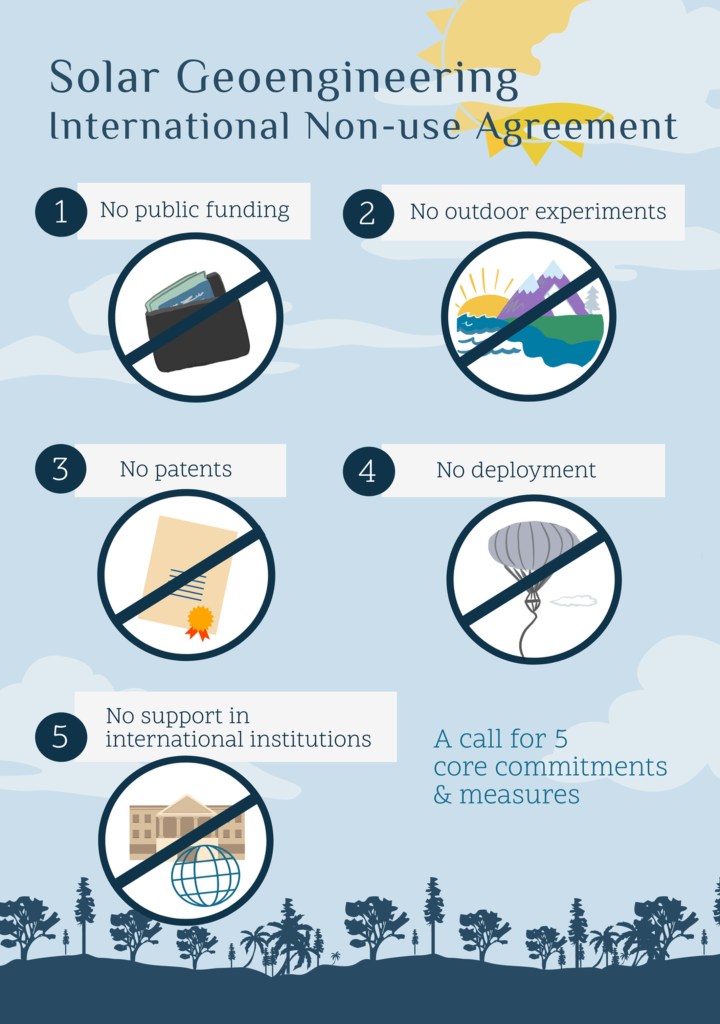
Solar geoengineering: The case for an international non-use agreement
Frank Biermann, Jeroen Oomen, Aarti Gupta, Saleem H. Ali, Ken Conca, Maarten A. Hajer, Prakash Kashwan, Louis J. Kotzé, Melissa Leach, Dirk Messner, Chukwumerije Okereke, Åsa Persson, Janez Potočnik, David Schlosberg, Michelle Scobie, Stacy D. VanDeveer
Abstract
Solar geoengineering is gaining prominence in climate change debates as an issue worth studying; for some it is even a potential future policy option. We argue here against this increasing normalization of solar geoengineering as a speculative part of the climate policy portfolio. We contend, in particular, that solar geoengineering at planetary scale is not governable in a globally inclusive and just manner within the current international political system. We therefore call upon governments and the United Nations to take immediate and effective political control over the development of solar geoengineering technologies. Specifically, we advocate for an International Non-Use Agreement on Solar Geoengineering and outline the core elements of this proposal.
20 January 2022
Rebuttal
The essay Solar geoengineering: The case for an international non-use agreement by Biermann et al. displays a breathtaking level of political foolishness and indifference to scientific solutions to the climate emergency. It reflects a dominant false thinking within the climate action movement, whereby political conflict with the fossil fuel industry is totally prioritised over any practical response to improve the future of the world. If our goal is a stable liveable climate, then banning geoengineering is the most stupid action imaginable.
The world reality is that the climate action movement lacks the political power to achieve anything close to the commitments under the Paris Accord. Emissions in 2030 are projected to be higher than in 2015. So instead they resort to bullying ideological argument typified by this call for a world fatwa against solar radiation management, seeking victory by intimidation rather than by reason.
All the bluster of arguments like this article will do nothing to slow emission growth, let alone slow warming. Meanwhile, extreme weather events continue a rapid escalation, and warming continues to inflict irreversible damage to biodiversity. But the authors are so caught up in their class-war type of thinking that they do not care about immediate measures to mitigate weather or extinction impacts.
The solution according to this article is to do precisely nothing in this decade that would have immediate material impact to mitigate extreme weather or climate-induced biodiversity loss. They flatly reject the observation that field research for a range of SRM methods could demonstrate easy, cheap, fast and safe activities. We should use scientific evidence rather than hypothetical speculation to answer serious questions about unintended consequences and optimal deployment strategies.
And contrary to the argument about geoengineering promoting conflict, the real likelihood is that activities such as refreezing the North Pole would serve to strengthen international cooperation, confidence, peace, dialogue and security. The G20 is likely to be the best forum for this debate. The UN is hopelessly corrupted by the type of ideological thinking seen in this article. Climate change is the primary material threat to global stability and security. Engaging the G20 to refreeze the North Pole could directly reduce the destabilising effects of extreme weather while also providing a major program to strengthen mutual respect and political stability.
These “governance scholars” express a number of opinions that are grossly ignorant of climate science. When the North Pole is melting, action to refreeze sea ice by increasing albedo could safely mitigate climate risks, returning toward previous stability. But no, that must be banned, because…
Their comment about marine cloud brightening recognises its potential to stop bleaching of the Great Barrier Reef. Field trials of MCB could also show ability to mitigate the strength of hurricanes and tornadoes, significantly reducing climate damage, especially for the poor, supporting climate justice. MCB could also cool water flowing into the Arctic, slowing down Greenland ice melt, permafrost melt, methane release and sea level rise.
It seems none of this has occurred to these authors in their mindless advocacy of political polarisation.
Decarbonising the economy will do precisely nothing to stop the pole from melting. Instead, the argument of this paper is to delay any real mitigation of climate change until long after expected tipping points could have shifted our planet into a hothouse phase. Opposition to SRM is no solution at all.
Comment on National Academies of Sciences, Engineering, and Medicine (NASEM) 2021. A Research Strategy for Ocean-based Carbon Dioxide Removal and Sequestration. Washington, DC: The National Academies Press
This NASEM report is immensely important as a public statement of current scientific consensus on the potential of ocean-based carbon dioxide removal to help stabilise the climate. However, in my view it is deficient due to its unstated acceptance of political pressures that distort its findings away from the best scientific information and practical implementation strategies. I did not engage with the report production process but hope that discussing it now will be of some value. I would welcome any challenge to my opinions expressed here as these are highly complex scientific and political issues that are important for our planetary future.
I have taken a strong interest in this topic since 2007, when I worked for the Australian Government on forest climate policy. I then formed the view that ocean-based CDR must become central to climate policy as the only option able to deal with the magnitude of the climate threat. That led me to work addressing large scale ocean-based algae production, linked to deep ocean water upwelling and ocean iron fertilization, including with iron salt aerosol.
A main problem arises from the following statement repeated in the summary and synthesis sections of the NASEM report as a key guiding policy principle:
“While rapid and extensive decarbonization and emissions abatement of other greenhouse gases in the U.S. and global economies are the primary action required to meet international climate goals, ocean-based and other CDR approaches could help balance difficult-to-mitigate human CO2 emissions and contribute to mid-century to late-century net-zero CO2 emission targets.”
(p2, p213)
This statement represents current political consensus but is not itself based on scientific evidence and supports an incorrect strategic direction for climate policy. Cutting emissions alone falls far short of the action needed to prevent warming of 2°C, let alone the more stringent targets needed to prevent dangerous climate change. The NASEM claim should therefore be challenged as a dangerous underestimate of the severity of climate risk and the scale and urgency of the required response. It wrongly implies that cutting emissions could prevent dangerous warming, even though temperature and sea levels were far higher than at present when our planet last had current GHG levels. The statement ignores the problem of committed warming from past emissions, which is the main reason why CDR is needed, not to ‘balance’ the much smaller problem of ongoing emissions.
Cutting emissions can only slow the rate of GHG increase and cannot cut existing GHG levels. That means the IPCC goal of net zero emissions would produce an end result of radiative forcing much higher than at present. Even at current GHG levels, unforeseen tipping points could lead to a hothouse earth. Decarbonisation as “primary action” as proposed by NASEM therefore represents a complacent and inadequate climate strategy, despite its popular support.
In fact, far from being “the primary action required” to stop dangerous warming, cutting emissions is far too small, slow and contested to achieve this climate goal. In the long term, CDR is needed to remove the trillion tonnes of carbon equivalents that humans will have added to the atmosphere by mid-century. CDR at much larger scale than total emissions will be the primary climate action required. Against that scale, emission reduction can make only a marginal contribution. Cutting emissions could at best reduce C addition by about 2-5 Gt C per year, given the intransigence and power of fossil fuel users, although even that looks very difficult. The bulk of the work to achieve net zero emissions has to come from ocean-based CDR. This work could provide the momentum to scale up CDR to double total emissions, 30 Gt C per year, or 100 Gt CO2 equivalents. Only the ocean has the available area, energy, and resources needed to deliver CDR at that scale. In the interim, while ocean solutions are developed, action to brighten the planet and reflect excess solar radiation is the most immediate and urgent global responsibility to prevent climate tipping points. That whole strategic outlook is excluded by the premise of the NASEM report.
Rather than accepting this prevailing orthodoxy of a focus on cutting emissions, climate policy should discuss more ambitious goals. An ambitious target of ocean-based CDR could be annual net removal of 30 Gt C. Using the massive area, energy and resources of the world ocean to stabilise and restore the planetary climate by achieving this target is technically possible but would require a major paradigm shift from the view that decarbonisation is primary.
The second defect of the quoted NASEM statement is in its assertion that “ocean-based and other CDR approaches could help balance difficult-to-mitigate human CO2 emissions and contribute to mid-century to late-century net-zero CO2 emission targets.” Again, this assertion expresses current broad IPCC policy consensus, but its logic and vision are flawed. The conceptual connection it proposes between new emissions and CDR makes no sense. CDR removes well-mixed CO2 emitted a thousand years ago and is needed on a scale far exceeding total emissions. The “balancing” concept adopted by NASEM from IPCC literature is therefore fundamentally misleading, orders of magnitude smaller than the need. It appears to be political in intent, designed to retain the political primacy of the strategy of emission reduction through shutting down fossil fuel industries. Unfortunately, this way of thinking ignores how this current orthodoxy presents immense risks and challenges, including opposition from major world governments and industries despite their lip service. The fifty-year time frame for scaling up CDR suggested in the NASEM policy statement is grossly inadequate against the real climate security risks. This timeframe should instead be compressed to target large ocean CDR deployment within this decade.
This NASEM strategic policy statement represents a complacent political strategy that colours the analysis of the entire report. The unfortunate situation is that such complacency dominates climate policy advocacy. It produces a timid and hostile approach toward geoengineering with a lowest common denominator position in which the immediate need for climate repair is ignored.
Since studying ocean algae as a climate solution for more than a decade, I have recognised ocean iron fertilization as a primary strategy to increase ocean algae biomass, together with upwelling and seaweed production. I therefore read the NASEM Chapter Three on Nutrient Fertilization with great interest and look forward to reading the other chapters. My comments below are solely on the Nutrient Fertilization discussion, primarily addition of iron.
The discussion of nutrient fertilization contains much informative technical material and excellent references to scientific research. However, I was surprised by the assertion (Summary Table S1, p7) that enhanced fisheries is possible but has not been shown and is difficult to attribute. This criticism appears to conflict with available analysis. There is a strong intuitive argument that adding iron, especially where targeted to optimise the fisheries life cycle by fertilizing waters where juvenile fish are most vulnerable to starvation, can be as effective as fertilizer on land. Of course, fish are underwater and moving around, unlike wheat. The measurement and verification challenges can only be met by field implementation, not by theoretical debate.
The report recognises that increase in photosynthesis from addition of iron is proven, while noting that debate continues about how much iron fertilization increases long term removal of CO2. The only way to resolve such debate is through more field trials. Regrettably, field tests have been under an effective political ban for the last decade, despite their high potential to help mitigate climate change, increase world food stocks and enhance biodiversity. The report does not really engage with this intimidating political context, reflecting the cautious attitudes that generally characterise scientific literature.
The origin of the political ban on iron fertilization arose from attacks on the fisheries enhancement work of one of its main proponents, Russ George, who has been the target of a vicious and sustained political campaign of disinformation and intimidation since leading the Haida Salmon experiment in 2012. This campaign has included bizarre and unconscionable strategies, such as mobilising the resources of the United Nations to declare that efforts to enhance salmon fisheries constitute dumping of waste, preventing collegial scientific discussion, and arranging for the Government of Canada to steal project data. A 2019 update at https://www.vox.com/the-highlight/2019/5/24/18273198/climate-change-russ-george-unilateral-geoengineering states “George points out that, according to the Alaska Department of Fish and Game, the year after his venture saw a recordsalmon harvest. He also insists that the data he was collecting would have demonstrated that he had succeeded in removing carbon, if the Canadian government hadn’t seized it for an investigation.”
A description of some of these problems is at https://russgeorge.net/2013/03/30/swat-team-swarms-village-science-office-with-overwhelming-force/. It states “the entire scientific data collection of the office has been taken, notebooks and journals, electronic data, legal files, reference books, scientific paper collections, much of what we work with on an everyday basis. So far in spite of being told we would be given a list of what they took no such list has arrived.” I understand much of this material was never returned. Such serious allegations of political misconduct should be recognised as constraining the scientific context of this activity, and should be recognised in the NASEM report, not ignored and distorted.
The intimidatory political context is further described at https://russgeorge.net/2013/03/29/scientists-given-notice-speak-to-haida-salmon-at-your-peril/, with distinguished scientists allegedly placed on a Canadian government blacklist for cooperating with the project. This illustrates how the policy context for this work has been badly corrupted by political influence. The tragedy of this influence is that it sets the agenda of political polarisation as more important than cooperation to fix the climate or restore fisheries. This polarised approach was explained by anti-geoengineering campaigners at Greenpeace, when Dr. Paul Johnston, head of Greenpeace International’s science unit, said in an ETC Group press release “Climate change should be tackled by reducing emissions, not by altering ocean ecosystems”. This stance is unscientific and mercenary, reflecting the ignorant prejudices of the Greenpeace donor base rather than empirical evidence.
The NASEM chapter on Nutrient Fertilization does not adequately explain this political context, which I would have thought should be essential to explaining why there have been no field tests for a decade. The chapter is quite badly organised, opening with highly uncertain, jargonistic and hypothetical analysis of the potential for permanent sequestration. As I read this chapter, I found myself wondering why the practical justification provided by the potential of ocean pasture replenishment as a way to improve fisheries productivity was not mentioned. It would provide the obvious, safe, simple and cheap way to test all the hypothetical problems and questions about longer term effects, and could be paid for by levies on the expected enhanced fish catch.
The report section 3.5 Viability and Barriers has a sub-section titled Fisheries that covers some of these questions, noting the obvious argument that fertilizing fishery locations could alleviate world hunger. The discussion of the 2012 Haida Salmon Restoration Corporation project led by Russ George does not read as balanced or astute.
It makes the extraordinary comment that the Haida project “was lacking in the public release of data or peer-reviewed studies documenting the impacts. While after-the-fact study of remote sensing images and plankton sampling did document a bloom within the study area (Batten and Gower, 2014; Xiu et al., 2014), no links could be made to enhanced fisheries. We are thus left with no evidence on the potential positive or negative impacts on fisheries of the 2012 event.”
Contrary to this NASEM assertion, Batten and Gower state “The evidence suggests that the iron-induced phytoplankton bloom in August [created by Russ George] fuelled the increase of crustacean zooplankton.” Together with claims from Russ George at https://russgeorge.net/2013/10/11/record-salmon-returns/, this cited scientific paper casts doubt on the NASEM assertion of no links between ocean pasture restoration work and enhanced fisheries.
As many of Russ George’s blog articles make clear, the assertion of a lack of data is disingenuous, and obviously has not been properly checked with sources. If scientists were blacklisted for speaking to the Haida project, and the Canadian government stole its data, it is unsurprising that there is a lack of peer reviewed analysis. The cited paper by Batten and Gower appears to contradict NASEM’s conclusion.
To illustrate how a narrow scientific approach can distort analysis of such a highly political topic, consider the NASEM statement “of significance to ocean CDR is (1) the need for through [sic] measurements and models, to quantify the permanence for a given site, and (2) deliberately selecting sites and enhancing export efficiencies to optimize for maximal sequestration time.” At face value this is reasonable, but in political context it is not reasonable, in view of the fervent popular view that such research must be prevented as the slippery slope to geoengineering deployment. It may be instead more sensible to explore if ocean fertilization could start with a focus on profitable fisheries enhancement, and then use practical lessons from scaling up this work to assess CDR potentials, rather than speculating about long term CDR in the absence of hard data from commercial sites.
A key observation in the NASEM chapter, which it does not seem to adequately address, is that “any attempt to deliberately alter the oceans’ Biological Carbon Pump will have consequences that should be considered relative to the status quo of doing nothing.” This is a highly charged political assertion, because this way of thinking appears to be basically ignored by the IPCC. Doing nothing presents existential risks which some see as potentially creating climate collapse, even as extreme as the Great Dying at the end of the Permian Age. Against that, the risks of testing ocean iron fertilization are minimal, easily addressed by stopping implementation. The main risk is political, that it will demonstrate that the approach to climate change proposed under the Paris Accord is unworkable.
To which I commented with the following rather disgruntled response.
In this summary, Catherine Brahic from The Economist refers to Glasgow as “Paris Plus”. That is the most naively rose tinted lily gilding silk purse from sow’s ear comment imaginable, up there with the emperor’s new clothes. In fact it is Paris Minus. For the last five years, nations have been meant to be ratcheting up their Paris pledges, but suddenly we get to Glasgow and find the cupboard is bare.
The ratchet mechanism from Paris has failed, turning out more rat shit than ratchet. It is as though Brahic sees a remarkable positive in recalcitrant nations having suddenly discovered that the IPCC actually calls on them to reduce their emissions. But this failure was inevitably built into the spinning nonsense of the Paris Accord.
The tragic farce here is the avoidance of the reality that only geoengineering will prevent dangerous warming in this decade. The resolute refusal to engage this basic science of global security is likely to prove the most gross dereliction of planetary duty in all human history.
Letter sent to The Guardian and the NY Times on October 17, 2021
17 October 2021
We can still avert climate disaster
Dear editor,
Bill McKibben writes: “We’ve been very lucky. We can still avert climate disaster” (Guardian 16th October). We are indeed heading towards climate disaster with increasingly extreme weather events occurring worldwide. People are coming to realise that the strategy of mitigation and adaptation has failed and intervention to reverse climate change is needed in short order. Our natural prejudice against intervention, reinforced by well-meaning activists such as McKibben, has to be overcome if we want to avert climate disaster and offer a better future for our offspring and the rest of humanity.
The Planetary Restoration Action Group (PRAG) which I chair has identified not only the means to reverse climate change but also how to restore the planet to a healthy state. PRAG now wants action. The top priority is to reverse the Arctic’s rapid warming which is the main driver of ever more extreme weather events and ever higher sea levels. Damage costs could quickly rise to trillions of dollars. Only prompt intervention with the most powerful cooling techniques can possibly reverse Arctic warming and restore Arctic ice. But there’s no commercial incentive for this, so governments must collaborate in a programme with ambitious targets such as proposed by PRAG in a letter to COP26 Parties. There must be the same urgency, intensity, determination and focus as in a war effort, fighting to refreeze the Arctic. Only then can the planet be restored to the safe, sustainable, biodiverse and productive state that our young people deserve for their future well-being.
Altering Earth’s geophysical environment is a moon shot—and it will be the only way to reverse the damage done. It’s time to take it more seriously.
WIRED OPINION – ABOUT
Parag Khanna is the author of Connectography (2016) and The Future is Asian (2019). Michael Ferrari is managing partner at Atlas Research Innovations and a senior fellow at the Wharton School.
IF GLOBAL WARMING were an extraterrestrial adversary, it would not have to fear a diplomatically unified Earth. The past decade of climate summits in Copenhagen, Bali, Cancun, and Paris have only nudged us towards the limp goal of business as usual until 2050. One wonders how much ice will be left in Greenland by then, and how many billions will have died from the ecocide of rising sea levels, endless droughts, and other climate-change-related catastrophes, to say nothing of the already tragic effects of natural disasters such as the wildfires burning with ever greater intensity in California. Even in the best of times, collective action doesn’t come naturally.
The time has come to place our faith in technological innovation rather than universal enlightenment. We have been wrestling with our habitat, and now it is fighting back. We are locked in a violent embrace in search of a new equilibrium.
If the Industrial Revolution and borderless capitalism are the forces that have brought us to this environmental apotheosis, then it will have to be geoengineering moon shots and scientific collaboration that buy us time to reverse the damage. Geoengineering proposals generally fall into two categories: removing carbon from the atmosphere, or shielding Earth from solar radiation. The most ambitious proposal for carbon removal involves fertilizing the ocean with iron sulfate and other nutrients to stimulate algae growth that could potentially revitalize the marine food chain while also absorbing atmospheric carbon. In terms of slowing global warming, injecting sulphur dioxide aerosol particles in the atmosphere would reflect sunlight and cool temperatures across the globe.
One might recoil at such audacious plans to intentionally alter the geophysical environment, yet that is precisely what we have unintentionally been doing for the past century. At least this time we can direct our efforts in the right direction. As Stewart Brand memorably wrote in the first edition of the Whole Earth Catalog in 1968, “We are as gods and might as well get good at it.”
We have a long way to go before we gain divine mastery over nature. More than a dozen iron fertilization experiments have been undertaken in the past two decades, but only two have resulted in any carbon being absorbed into the deep sea. Despite this limited success, in 2008 the United Nations Convention on Biological Diversity imposed a moratorium on such efforts.
Solar geoengineering lags even further behind. To date the only significant real-world initiative in the field is Harvard’s Stratospheric Controlled Perturbation Experiment (SCoPEx), which plans to inject calcium carbonate particles high above the Earth to reflect some of the sun’s rays back into space, effectively simulating a volcanic explosion over a small patch of desert in the southwestern US. Beyond the science, the chief obstacle to the project, according to director David Keith, is that funding agencies fear backlash from environmental groups. Similar to the fate of ocean fertilization, in 2019 a Swiss-backed proposal for a multilateral research initiative on atmospheric geoengineering was rejected.
This is as ironic as it is unacceptable. Activism has neither stopped oil producers (whether Saudi Arabia, Russia, Canada, or the US) from pumping hydrocarbons nor industrial consumers (such as China, India, the US, and Japan) from consuming them. The crucial change agent has been technology, primarily nuclear, solar, and wind power. But even under the best-case scenarios of renewable energy adoption, we are past the point of no return: Accumulated carbon emissions will wreak ever more havoc on all living organisms. It is well past time to abide by the precautionary principle—an ounce of prevention is worth a pound of cure.
We need to get all hands on deck. The combined resources of progressive government agencies, the scientific community, and private backers represent the political willpower, technical know-how, and financial muscle necessary to offset the current trajectory of 2°C or higher temperature rise, which estimates suggest could cost tens of billions of dollars per year. European and Asian governments support geoengineering in principle, and it now has bipartisan support in the US, which recently approved $4 million for the National Oceanic Atmospheric Administration (NOAA) to assess solar climate interventions. But this is half-hearted, timid support, and it will not be enough.
The environmental “Manhattan Project” we need would also require pooling together the innovation and resources of Bill Gates, who has invested billions in concentrated solar power and fusion reactors, Elon Musk, who has nearly single-handedly created the supply and the demand for a commercially viable market for electric vehicles, and potentially Jeff Bezos, whose Earth Fund is directing at least $10 billion towards climate initiatives, as well as other tech visionaries and the research organizations they support. Hopefully, today’s climate protagonists are already working to launch a range of geoengineering schemes, even if they have to do so in secret, shielded from climate-change-denying politicians and interest groups masquerading in the name of democratic accountability.
Governments and environmental advocates are right to demand that all organizations involved in geoengineering transparently disclose their funding, objectives, and results on sites such as Geoengineering Monitor. But right now, it is more important for such projects to be scaled in the first place. Given the infant state of geoengineering techniques and the cowardly state of global regulation, moral hazard is hardly our biggest concern. Governments and activists can continue to push for strong emissions reductions while blunting the consequences of those already choking us at the same time.
At this point, we no longer have any choice but to rely on scientific cost-benefit calculations to drive the climate agenda. But there is still a vital need for national efforts to shorten global supply chains for food and energy. The silver lining to climate disruptions, Covid border closures, and trade wars could be encouraging more countries to invest in local agriculture, whether organic or hydroponic greenhouses, plant-based proteins, and converting food waste into energy. Local self-sufficiency is a sensible step towards collective resilience. In the so-called circular economy, everyone can be part of the geoengineering solution.
Not all geoengineering is the stuff of Hollywood fantasy. Planting billions of trees from Canada and Russia to Brazil and China is an obvious example of building carbon sinks and refortifying habitats at the same time. Cloud seeding has been used since the 1970s and could help ameliorate today’s droughts. Coating fresh ice with white sand to reflect more light so it can strengthen rather than melt is another less invasive treatment for the wounded Earth. Of course, each of these approaches has its own challenges and limitations, ones that will require us to commit resources other than simply flying diplomats to summits to sign empty promises. Let us not pretend there is any other way to reduce the widening climate injustice.
WIRED Opinion publishes articles by outside contributors representing a wide range of viewpoints. Read more opinions here, and see our submission guidelines here. Submit an op-ed at opinion@wired.com.
 Planetary Restoration Action • Group